AI Agents on Blockchain: From Autonomy to On-Chain Intelligence

.jpg)
When software learns to act on its own, and the ledger keeps it honest
There is something deeply compelling about the idea of software that does not just respond to your commands but acts on your behalf. Not a chatbot that answers questions. Not a script that follows a rigid set of rules. An agent, a system that perceives its environment, reasons about what to do next, selects from a set of tools, and takes action, all without waiting for a human to approve every step. Now imagine giving that agent a wallet, access to smart contracts, and the ability to move real value on a blockchain. That is where things get interesting, and where things get dangerous.
The convergence of artificial intelligence and blockchain technology addresses a genuine architectural problem: AI systems are increasingly capable of autonomous action, but we have no trustworthy infrastructure for letting them operate in high-stakes environments without centralised oversight. Blockchains provide exactly that infrastructure. They offer deterministic execution, public auditability, permissionless access, and programmable rules that even the agent itself cannot bend. Meanwhile, AI brings adaptability, natural language understanding, and decision-making under uncertainty, capabilities that rigid smart contracts fundamentally lack.
This article will walk you through the full landscape of AI agents on blockchain. We will start with what agents actually are, move through the architectural decisions that define how they interact with on-chain systems, examine the frameworks and protocols that make this possible, and end with the hard problems that remain unsolved.
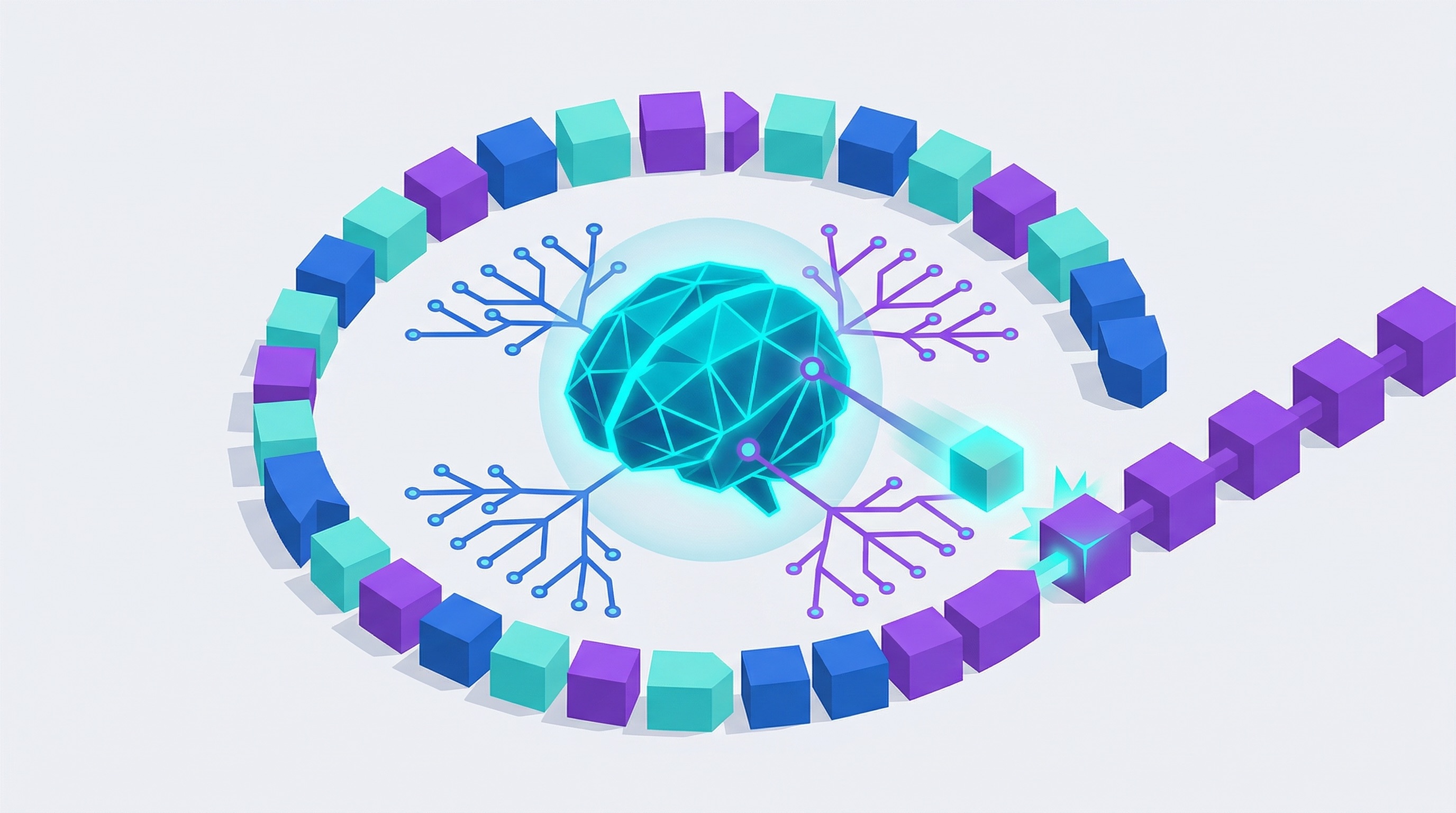
Part 1: What AI Agents Actually Are
Beyond Chatbots
The term "AI agent" gets thrown around loosely, so let us be precise. A chatbot takes your input, generates a response, and waits for your next message. An agent does something fundamentally different: it operates in a loop. It observes the state of its environment, constructs a plan to achieve a goal, selects and executes actions (often by calling external tools), observes the results, and iterates. This is commonly called the ReAct (Reasoning and Acting) paradigm in AI research.
What makes modern AI agents qualitatively different from the rule-based agents of earlier decades is the foundation model at their core. Large language models give agents the ability to reason in natural language, interpret ambiguous instructions, decompose complex tasks into subtasks, and recover from unexpected failures. When you combine this reasoning capability with tool use, the ability to call APIs, execute code, or sign blockchain transactions, you get something that looks less like a chatbot and more like a junior analyst with a terminal.
The key properties of a genuine AI agent are:
- Autonomy: It can operate without human intervention for extended periods.
- Tool use: It can interact with external systems, not just generate text.
- Planning: It can break down goals into steps and sequence them.
- Memory: It can retain context across interactions, both short-term and long-term (often via vector databases or on-chain state).
- Adaptability: It can adjust its behavior based on feedback from the environment.
The Agency Spectrum
Not every system that touches both AI and blockchain deserves the label "agent." It helps to think of a spectrum. At one end, you have simple AI-assisted interfaces: a frontend that uses an LLM to help a user draft a swap transaction. The human still approves and signs everything. In the middle, you have co-pilot systems: AI that monitors a DeFi portfolio, suggests rebalancing strategies, and prepares unsigned transactions for review. At the far end, you have fully autonomous agents: systems that hold their own private keys, execute trades, participate in governance votes, and manage treasury funds, all without human approval for individual actions.
Most production systems today sit somewhere in the middle. Fully autonomous agents operating with real capital and no human oversight remain rare, and for good reason.

Part 2: Why AI and Blockchain Complement Each Other
AI models are black boxes. Even if you run the same prompt through the same model, subtle differences in inference infrastructure can produce different outputs. This makes it extremely difficult to prove that an AI agent did what it claims to have done. Blockchain solves this from the other direction. Smart contracts execute deterministically. Every node runs the same code on the same inputs and arrives at the same result. If an AI agent submits a transaction to a smart contract, the contract's logic is the final arbiter of what happens.
This creates a powerful division of labor: the AI handles the messy, probabilistic work of perception, reasoning, and strategy. The blockchain handles the clean, deterministic work of execution, settlement, and enforcement.
What Blockchain Gives AI:
- Permissionless access: An AI agent can interact with any public blockchain protocol without needing an API key or permission from a gatekeeper.
- Composability: An agent can combine actions across multiple protocols in a single atomic transaction.
- Trustless settlement: Once a transaction is confirmed, it is final. No counterparty risk.
- Transparent rules: Constraints can be encoded in smart contracts that anyone can audit.
What AI Gives Blockchain:
- Adaptability: AI agents can respond to novel situations that no fixed rule set could cover.
- Natural language interfaces: Users can interact with complex protocols using plain language.
- Optimisation: DeFi strategies involve multi-dimensional optimisation that benefits from learned models and real-time reasoning.
- Governance automation: AI agents can summarise, analyse, and participate in governance processes at scale.
Part 3: On-Chain vs. Off-Chain Architectures
This is one of the most important architectural decisions in the space.
Fully Off-Chain Agents run entirely on a server or local machine. The agent monitors on-chain state via RPC or indexers, reasons using an LLM, and when it decides to act, it signs and broadcasts a transaction. This is how most AI agents operate today. The advantages are clear: full LLM power, no gas costs for reasoning, and access to off-chain data. The disadvantage: the reasoning process is invisible to the blockchain. You are trusting the operator completely.
Hybrid Architecture separates reasoning (off-chain) from execution constraints (on-chain). The agent's wallet is a smart contract wallet, often built on ERC-4337 (account abstraction), that enforces rules: maximum transaction value, whitelisted target contracts, required time delays. Even if the agent is compromised, the on-chain guardrails limit the damage.
Fully On-Chain Agents are severely limited in practice. The EVM is not designed for LLM inference or complex optimisation. What you do see are on-chain agent registries where identity, reputation, and economic commitments are recorded on-chain, while the cognitive work happens off-chain. Protocols like Autonolas (Olas) and Fetch.ai take this approach.

Part 4: Agent Frameworks and Protocols
LangChain and LangGraph provide general-purpose abstractions for chaining LLM calls, tool use, memory, and retrieval. While not blockchain-specific, they are the foundation many blockchain agent projects build on. You define blockchain interactions as "tools" and LangChain handles orchestration.
ElizaOS (ai16z) is specifically designed for crypto-native environments. It provides a runtime for agents that can interact with multiple blockchains, social media platforms, and DeFi protocols. Agents built on ElizaOS can hold wallets, execute swaps, manage treasuries, and post on social media autonomously. The framework is plugin-based, allowing modular support for new chains and protocols.
Autonolas (Olas) provides a protocol for multi-agent systems rather than individual agents. Agent services run collectively, reach consensus among themselves, and execute on-chain transactions as a coordinated unit. Each service is registered on-chain with its code hash, operator set, and economic bonds publicly visible. If an agent misbehaves, staked tokens can be slashed.
Fetch.ai provides a decentralised network where agents discover each other, negotiate, and transact. Agents are identified by DIDs and communicate via the Almanac registry. The platform includes its own Cosmos-based blockchain and native token (FET).
Other notable projects include Virtuals Protocol (tokenised AI agents on Base), WASP by Naptha AI (multi-agent workflow orchestration), and Brian AI (natural language to transaction interfaces).
Part 5: How Agents Interact with Smart Contracts
When an AI agent interacts with a blockchain, the process involves five steps:
- Read on-chain state: Query contract storage, balances, pool reserves, or event logs via RPC calls or indexers like The Graph.
- Construct transactions: Determine which contract function to call, with what parameters, using the contract's ABI and libraries like ethers.js or viem.
- Estimate and manage gas: Set appropriate gas prices and manage nonces.
- Sign and broadcast: Sign with the agent's private key and submit to the network.
- Monitor results: Check for transaction inclusion, parse event logs, update internal state.
The LLM's role is typically at steps 1 and 2: interpreting the current state and deciding which action to take. The actual transaction construction and signing is handled by deterministic code, not the LLM. You do not want a language model hallucinating a function signature.
Modern LLMs support structured "function calling" natively. The framework defines tools like swap(token_in, token_out, amount), supply(protocol, asset, amount), or vote(proposal_id, support), and the LLM selects which to invoke based on its reasoning. The framework translates these high-level calls into raw transaction data.
Part 6: What Agents Actually Do On-Chain
DeFi Agents automate strategies that would be tedious or time-sensitive for humans. Yield optimisation agents monitor rates across protocols and continuously rebalance assets. Liquidation agents predict which positions will become liquidatable based on price trends. Market-making agents dynamically adjust concentrated liquidity positions on Uniswap v3/v4. More controversially, AI agents participate in MEV extraction, identifying arbitrage and other profitable transaction-ordering strategies.
Governance Agents address voter apathy and information overload in DAOs. They summarise proposals, analyse on-chain effects of parameter changes, vote according to predefined principles, and flag proposals requiring human attention.
Social Media Agents maintain autonomous social media presences, posting market commentary, engaging with communities, and sharing analytics based on real-time on-chain events.
Analytics Agents crawl on-chain data, classify wallet behavior, detect anomalies like potential exploits or rug pulls, and produce reports. When paired with execution capabilities, these become the "eyes" of a larger multi-agent system.
Part 7: Multi-Agent Orchestration
Single agents are powerful. Networks of agents are transformative. Consider managing a treasury across multiple chains. One agent specialises in bridge liquidity, another in Ethereum yield opportunities, a third in Solana strategies. A coordinator agent decomposes the goal into sub-tasks, assigns them to specialists, and executes the final plan.
This introduces challenges around communication protocols, consensus and conflict resolution, task decomposition, and incentive alignment. Olas addresses this by requiring agent services to reach internal consensus using BFT-like protocols before executing on-chain, with staking and slashing for economic security.
The vision many teams are working toward is an "economy of agents," a network where AI agents autonomously discover, negotiate with, and transact with each other. We are in the early stages of this.
Part 8: Trust, Verification, and the Oracle Problem
Here is the core tension: blockchains are trustless, but AI models are not. A smart contract executes deterministically. An LLM is stochastic. There is no way for a smart contract to verify that an agent's off-chain reasoning was performed correctly.
TEEs (Trusted Execution Environments) like Intel SGX or TDX provide hardware-based secure enclaves where even the operator cannot inspect the computation. The TEE produces an attestation proving specific code ran on specific inputs. Phala Network provides a decentralised TEE cloud for running verifiable AI agents. The disadvantage is hardware trust: you are replacing "trust the agent operator" with "trust Intel."
zkML (Zero-Knowledge Machine Learning) uses ZK proofs to verify AI inference cryptographically. Technically possible but currently impractical for large models. Projects like EZKL have demonstrated proofs for small models, but we are years away from proving inference for billion-parameter models at reasonable cost.
Optimistic Verification borrows from the optimistic rollup playbook. The agent posts its action with a challenge period. If disputed, the reasoning is re-executed and adjudicated. Cheating is penalised via slashing. This does not provide cryptographic proof but provides economic security.
Part 9: Security Concerns
Prompt Injection: If an agent processes on-chain text (token names, proposal descriptions, transaction data) through its LLM, an attacker could embed malicious instructions that hijack the agent's reasoning. The high-value, irreversible nature of blockchain transactions makes this especially dangerous.
Private Key Management: An autonomous agent needs a private key to sign transactions. Where it is stored matters critically. MPC wallets, HSMs, TEEs, and smart contract wallets with spending limits provide defense in depth.
Economic Attacks: Agents interacting with DeFi are exposed to flash loan attacks, oracle manipulation, sandwich attacks, and trap pools designed to drain automated participants. Sophisticated agents need adversarial awareness.
Model Poisoning: If an agent uses fine-tuned models or RAG with external data, those sources become attack vectors. An attacker influencing the agent's knowledge base can subtly steer its behavior.
Part 10: The Road Ahead
Several fundamental problems remain. LLMs hallucinate, and even a 1% error rate is unacceptable for agents managing real capital. Inference latency can be the difference between profit and loss in fast-moving markets. Running large models is expensive. And regulatory uncertainty around autonomous financial agents is unresolved in virtually every jurisdiction.
Despite this, several trends point forward. Account abstraction (ERC-4337 and successors) makes smart contract wallets with built-in safety features dramatically easier. Chain abstraction enables agents to operate across multiple blockchains seamlessly. Inference costs are falling as hardware and model efficiency improve. TEE infrastructure is maturing while zkML develops for the longer term.
The most likely near-term trajectory is not fully autonomous agents without oversight. It is a gradual expansion of the action space agents are trusted to operate within, starting with bounded, low-stakes tasks and expanding as verification technology and track records improve.
The infrastructure is being built. The frameworks exist. The first generation of real agents is live and transacting. What happens next depends on engineering, not hype.
References
- Yao, S. et al. (2023). "ReAct: Synergising Reasoning and Acting in Language Models." ICLR 2023.
- Ethereum Foundation (2023). "ERC-4337: Account Abstraction Using Alt Mempool." https://eips.ethereum.org/EIPS/eip-4337
- Autonolas Documentation. "Autonomous Services." https://docs.autonolas.network/
- Fetch.ai Documentation. "Agent Framework." https://fetch.ai/docs
- ElizaOS GitHub Repository. https://github.com/elizaOS/eliza
- LangChain Documentation. "Agents." https://python.langchain.com/docs/modules/agents/
- Phala Network. "AI Agent Contract." https://docs.phala.network/
- Costan, V. & Devadas, S. (2016). "Intel SGX Explained." IACR Cryptology ePrint Archive, Report 2016/086.
- EZKL. "Verifiable Inference for Machine Learning." https://docs.ezkl.xyz/
- Greshake, K. et al. (2023). "Not What You've Signed Up For: Compromising Real-World LLM-Integrated Applications with Indirect Prompt Injection." AISec 2023.
- Artificial Superintelligence Alliance. "ASI Merger: Fetch.ai, SingularityNET, Ocean Protocol." https://superintelligence.io/
- CoinGecko. "AI Agents in Crypto." https://www.coingecko.com/research/publications/ai-agents-crypto
- Virtuals Protocol Documentation. https://docs.virtuals.io/
- a16z Crypto. "The Promise and Challenges of Crypto + AI Applications." https://a16zcrypto.com/posts/article/the-promise-and-challenges-of-crypto-ai-applications/

.jpg)
